
Flashing and Penetration Leaks on San Antonio Roofs
Most roof leaks that owners can point to start at a joint, not in the middle of a sound field. Flashing leaks show up at chimneys, sidewalls, valleys, and pipes. San Antonio wind and hard rain make those joints worth a specific question.
Best Roofers Network does not repair flashing. Compare contractors on the San Antonio roofing directory after you can describe the joint.
Name the joint
A chimney, a dormer wall, a skylight curb, and a valley are different details. “The roof leaks” sends a contractor hunting. “The stain is beside the chimney on the north wall” lets them start at the flashing.
Pipe boots crack in the sun. The shingles around them may still be fine. Replacing the whole slope because a boot split is a different job. Ask which one you are buying.
- Chimney step flashing and counterflashing
- Sidewall step flashing
- Valley metal or woven valleys
- Skylight curbs
- Pipe boots and vent collars
What sealant can and cannot do
Sealant can close a small gap in sound metal. It cannot replace flashing that has pulled out of a wall or rusted through. A smear over a failed joint often leaks again at the next storm.
Ask the contractor whether they will rebuild the detail or coat it. If they rebuild it, ask how far the new metal extends under the shingles or siding.
| Detail | A clear repair names |
|---|---|
| Chimney | Step flashing, counterflashing, and the cricket if there is one |
| Sidewall | Step flashing tucked under the siding, not only caulked on the face |
| Valley | Whether the metal is replaced and how the shingles meet it |
| Pipe boot | A new boot and the shingles that have to come up to install it |
| Skylight | The curb flashing, not a bead of sealant on the glass |
Clues inside the house
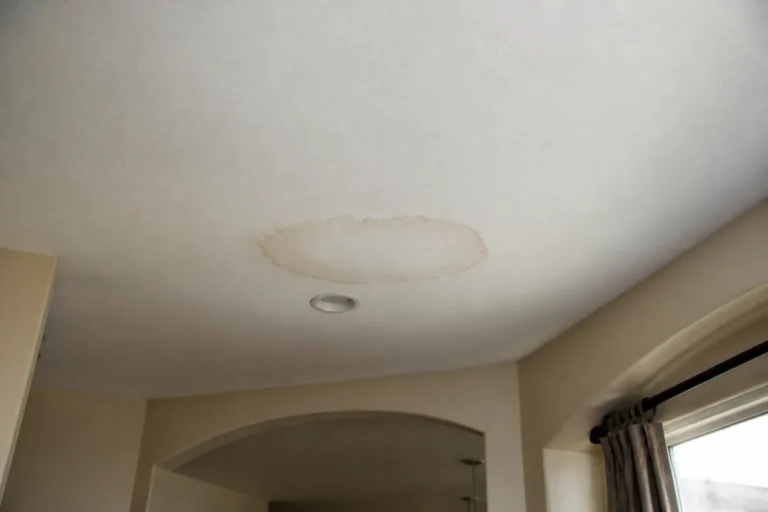
Stains that appear beside a chimney or under a skylight are location clues. The leak-sign article walks through interior evidence. Date the photos.
A leak only during wind-driven rain often means water is blowing up under a joint. That still needs a person who can see the joint. It does not tell you the field shingles are finished.
Storm damage at the edges
Wind lifts edge metal and ridge pieces. Hail dents caps and vents. Those marks belong in the storm damage guide and the after-hail checklist. Flashing repairs and a full replacement can both be discussed. They should not be blurred.
Photograph from safe places
From the ground, photograph the chimney, the sidewall, and any bent metal. Inside, photograph the stain with a date. That pair is enough to request an inspection.
Do not lift shingles or pull siding to “show the flashing.” You can open a larger leak and injure yourself.
Put the detail in the scope
The proposal should name the joint. If the price is for “leak repair” with no location, ask them to add the location before you compare it with another bid.
- Mark the room and the nearby roof feature
- Ask whether metal will be replaced
- Ask what surrounding shingles must come up
- Keep sealant-only work labeled as sealant-only
Treating flashing leaks as detail work keeps the repair honest. You can still replace a worn roof later. You do not have to start there.
If two inspections disagree, ask each person to point at the same joint in a photo. The disagreement should be about that metal, not about a slogan. You can request a third look if the building still leaks and the notes do not match.
Write the address, the side of the house, and the nearby feature on the photo note. “North chimney” is more useful than a close crop with no context. Bring that note to the second visit so the conversation starts at the same joint.
Frequently Asked Questions
Get Free Roofing Quotes
Fast response. No spam. 100% free.